
If you want to know how much money people in the UK actually have available after tax, average disposable income UK is a useful figure to look at.
The latest official figures from the Office for National Statistics (ONS) show that median household disposable income in the UK was £36,700 in the financial year ending 2024. However, this does not mean that the average person in the UK has £36,700 left to spend each year. The figure is measured at household level, and median income is not the same as average income.
So, what is the average disposable income UK, how does it vary across the country, and how much money do people actually have left after paying for everyday life?
What is disposable income?
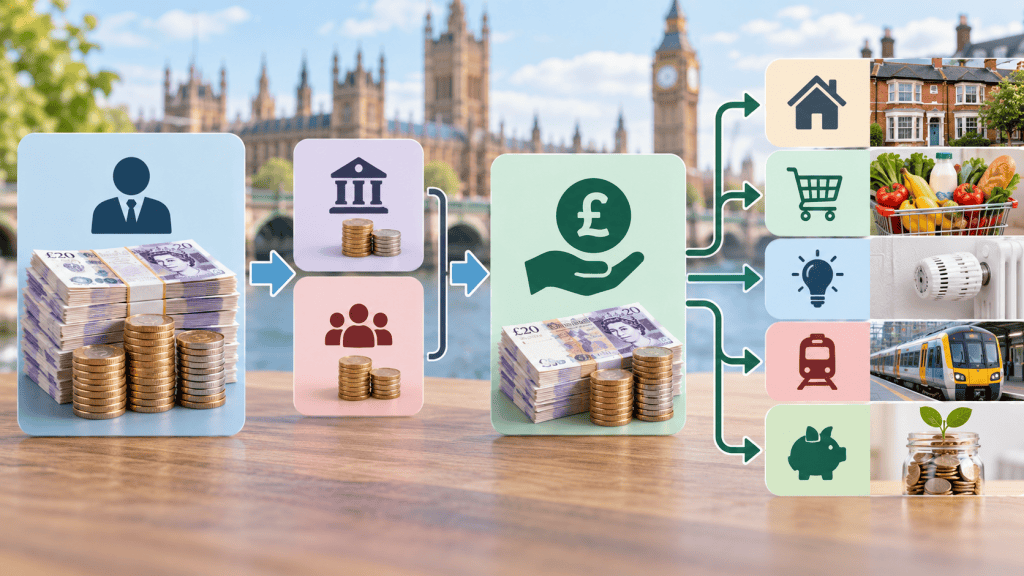
Disposable income is the money available to a person or household after direct taxes and other deductions have been taken into account.
It can be used for things such as:
- Rent or mortgage payments
- Food and groceries
- Energy bills
- Transport
- Entertainment
- Savings
- Other household expenses
There is an important distinction, though.
Disposable income is not the same as the money left after paying all your bills.
For example, imagine a household has £3,000 a month available after tax. If it spends £1,200 on rent, £400 on groceries and £300 on utilities and transport, it has £1,100 left after those expenses.
That £1,100 is what many people would describe as money left over. Official disposable-income statistics are calculated differently.
This distinction matters when comparing income with the cost of living in the UK.
What is the average disposable income in the UK?
The latest ONS data shows that median household disposable income was £36,700 in FYE 2024. This represented a 0.8% increase from the previous year, although ONS says the change was not statistically significant.
The word median is important.
A median is the middle point when households are ranked from the lowest income to the highest. In simple terms, half of households have less disposable income than the median and half have more.
This can be more useful than a simple mathematical average because a relatively small number of very high-income households can push the average upwards.
Average vs median disposable income
| Term | Meaning |
|---|---|
| Average income | Total income divided by the number of people or households |
| Median income | The middle value when incomes are ranked |
| Disposable income | Income available after direct taxes and deductions |
| Take-home pay | Money received from employment after deductions |
So, if you search for average disposable income UK, it is important not to interpret the ONS figure of £36,700 as the typical take-home pay of one person.
It isn’t.
It is the median disposable income of a UK household.
How much disposable income is there in different parts of the UK?
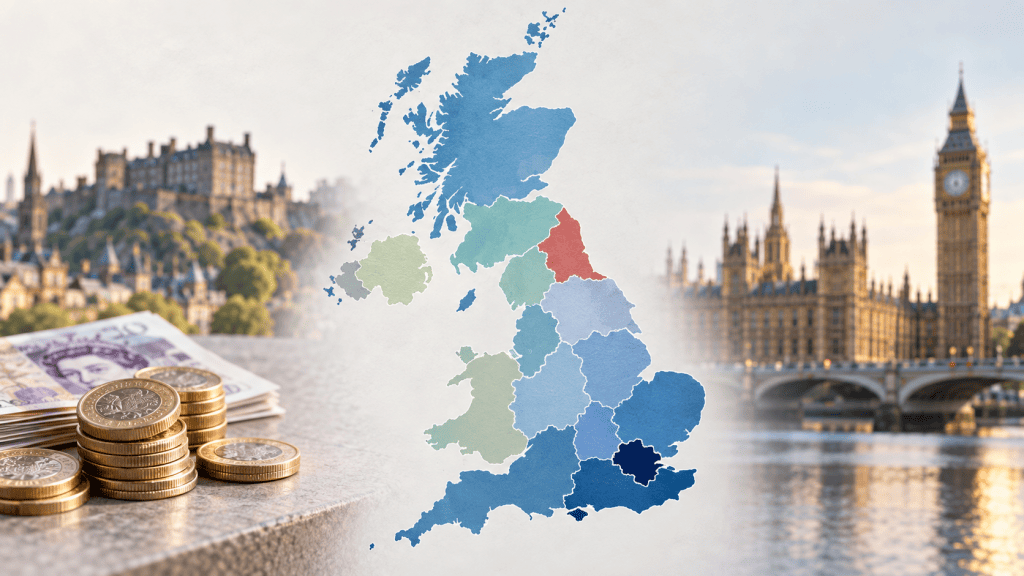
Where you live can make a significant difference.
According to the latest ONS regional figures, gross disposable household income (GDHI) per head was £25,965 across the UK in 2024.
London had the highest GDHI per head at £36,487, while the North East had the lowest at £20,562.
Here is how the UK regions compared:
| UK region | GDHI per head, 2024 |
|---|---|
| London | £36,487 |
| South East | £29,577 |
| East of England | £26,795 |
| South West | £25,924 |
| Scotland | £24,283 |
| East Midlands | £22,761 |
| North West | £22,523 |
| Northern Ireland | £22,258 |
| West Midlands | £22,064 |
| Yorkshire and the Humber | £21,913 |
| Wales | £21,469 |
| North East | £20,562 |
| UK | £25,965 |
These figures are GDHI per head, so they should not be directly compared with the £36,700 median household disposable income figure.
They are different measures.
However, they give a useful indication of how disposable household income varies across the UK.
Does London have the highest disposable income?
Yes, according to the latest ONS regional figures, London had the highest GDHI per head in the UK in 2024 at £36,487.
But this does not automatically mean that people in London have the most money left over at the end of the month.
London is also one of the most expensive places in the UK to live, particularly when it comes to housing.
This is why income should always be considered alongside living costs.
Someone earning more money in London could have less money left after rent and other essential expenses than someone earning less in a cheaper part of the country.
In other words:
Higher disposable income does not always mean a higher standard of living.
How much disposable income do you need to live comfortably in the UK?

There is no single amount that can be described as a comfortable disposable income for everyone.
Your financial situation depends on where you live and how you live.
A single person renting a small flat will have very different expenses from a couple with two children. Someone living in London will also face different housing and transport costs from someone living in the North East.
Some of the biggest factors are:
- Housing costs
- Rent or mortgage payments
- Number of people in the household
- Childcare
- Food
- Energy bills
- Transport
- Debt repayments
- Savings
- Entertainment
- Lifestyle
For example, having £2,500 a month available after tax might feel comfortable for one person in a relatively inexpensive area.
The same amount could feel very tight for a family renting an expensive home and paying for childcare.
That’s why there isn’t a magic disposable-income number that works for every household.
Disposable income vs salary
One of the easiest mistakes to make is to compare disposable income directly with your salary.
They are not the same thing.
Your gross salary is the amount you earn before Income Tax and other deductions.
Your take-home pay is the amount that reaches your bank account after deductions from your employment income.
Disposable income is a broader concept and can be measured at either individual or household level, depending on the statistic being used.
For the 2026–27 tax year, the standard UK Personal Allowance is £12,570. Income Tax rates and thresholds then depend on the amount of taxable income and, in Scotland, different Income Tax bands apply.
This means that simply knowing someone’s gross salary doesn’t tell you how much money they have available to spend.
How do you calculate disposable income?
For a simple personal estimate, you can start with your after-tax income.
For example:
Gross salary − Income Tax − National Insurance = approximate take-home income
You can then subtract your regular living expenses to work out how much money you actually have left.
For example:
| Monthly income and expenses | Amount |
|---|---|
| Take-home income | £3,000 |
| Rent | -£1,200 |
| Groceries | -£400 |
| Energy and utilities | -£250 |
| Transport | -£200 |
| Other essential costs | -£250 |
| Money remaining | £700 |
This is a much more personal way of looking at your finances than simply comparing your salary with the UK average.
Your actual tax calculation can be more complicated because it depends on your circumstances, income and location.
Is £36,700 a good disposable income?
It depends on the household.
The £36,700 figure is the median UK household disposable income, not a recommended salary and not the amount a single person needs to live comfortably.
A household with £36,700 of disposable income could consist of one adult, two adults or a larger family.
Their financial situations could therefore be completely different.
Location matters too.
£36,700 can go much further in some parts of the UK than in areas where rent and other living costs are significantly higher.
Instead of asking whether £36,700 is a “good” disposable income, it is more useful to ask:
How much money will I have left after my normal monthly expenses?
That figure gives you a much clearer picture of your financial situation.
What is the average disposable income by UK region?
The latest ONS figures provide a useful comparison between different parts of the country.
The UK average GDHI per head was £25,965 in 2024.
London was significantly above the UK average at £36,487 per head, followed by the South East at £29,577 and the East of England at £26,795.
At the other end of the table, the North East recorded £20,562 per head.
This difference is one reason that comparing salaries without considering location can be misleading.
A £40,000 salary may give you a very different lifestyle depending on whether you live in London, Manchester, Newcastle or a smaller town.
Why disposable income matters when comparing the cost of living
If you’re thinking about moving to the UK, disposable income is one of the figures worth looking at alongside salary.
For example, two cities may offer similar salaries but have very different rents.
If one city costs £500 more per month for housing, the higher salary in that city may not actually leave you with more money.
This is why a useful cost-of-living comparison should consider:
Income + housing costs + everyday expenses + money left over
rather than salary alone.
For people deciding where to live, the amount left after essential expenses can often tell you more than the headline salary.
Average disposable income UK: key figures
If you only want the main numbers, here is the short version:
- £36,700 — median UK household disposable income in FYE 2024.
- £25,965 — UK GDHI per head in 2024.
- £36,487 — London GDHI per head in 2024.
- £20,562 — North East GDHI per head in 2024.
- £12,570 — standard Personal Allowance for the 2026–27 tax year.
These figures shouldn’t be treated as interchangeable because they measure different aspects of household income.
Frequently asked questions
What is the average disposable income in the UK?
The latest ONS data shows that median household disposable income was £36,700 in the financial year ending 2024. This is a household figure rather than the disposable income of one individual.
What is the average UK disposable income per person?
There isn’t one single figure that can be used interchangeably with household disposable income. The ONS’s regional GDHI measure shows £25,965 per head across the UK in 2024. This is a different measure from median household disposable income.
Which UK region has the highest disposable income?
London had the highest GDHI per head in 2024 at £36,487, according to the ONS.
Which UK region has the lowest disposable income?
The North East had the lowest GDHI per head among the UK’s ITL1 regions in 2024, at £20,562.
Is disposable income the same as take-home pay?
No. Take-home pay is the amount you receive from your earnings after deductions. Disposable income is a broader measure and can refer to income available to a person or household after direct taxes and other deductions.
Is £36,700 enough to live comfortably in the UK?
It depends on your household and where you live. £36,700 is the latest median household disposable income figure, but housing, childcare, transport and other costs vary substantially across the UK.
Final thoughts
The average disposable income UK figure is useful, but it doesn’t tell the whole story.
The latest ONS data puts median household disposable income at £36,700, while regional GDHI per head ranges from £20,562 in the North East to £36,487 in London.
What matters for your own finances is not simply how much you earn.
It’s how much you have left after paying for the life you actually live.
That is why disposable income becomes much more useful when you look at it alongside rent, bills, food, transport and the wider cost of living.
If you’re comparing UK salaries, considering a move or trying to work out whether your income is enough, looking at both income and living costs will give you a much clearer picture than salary alone.