
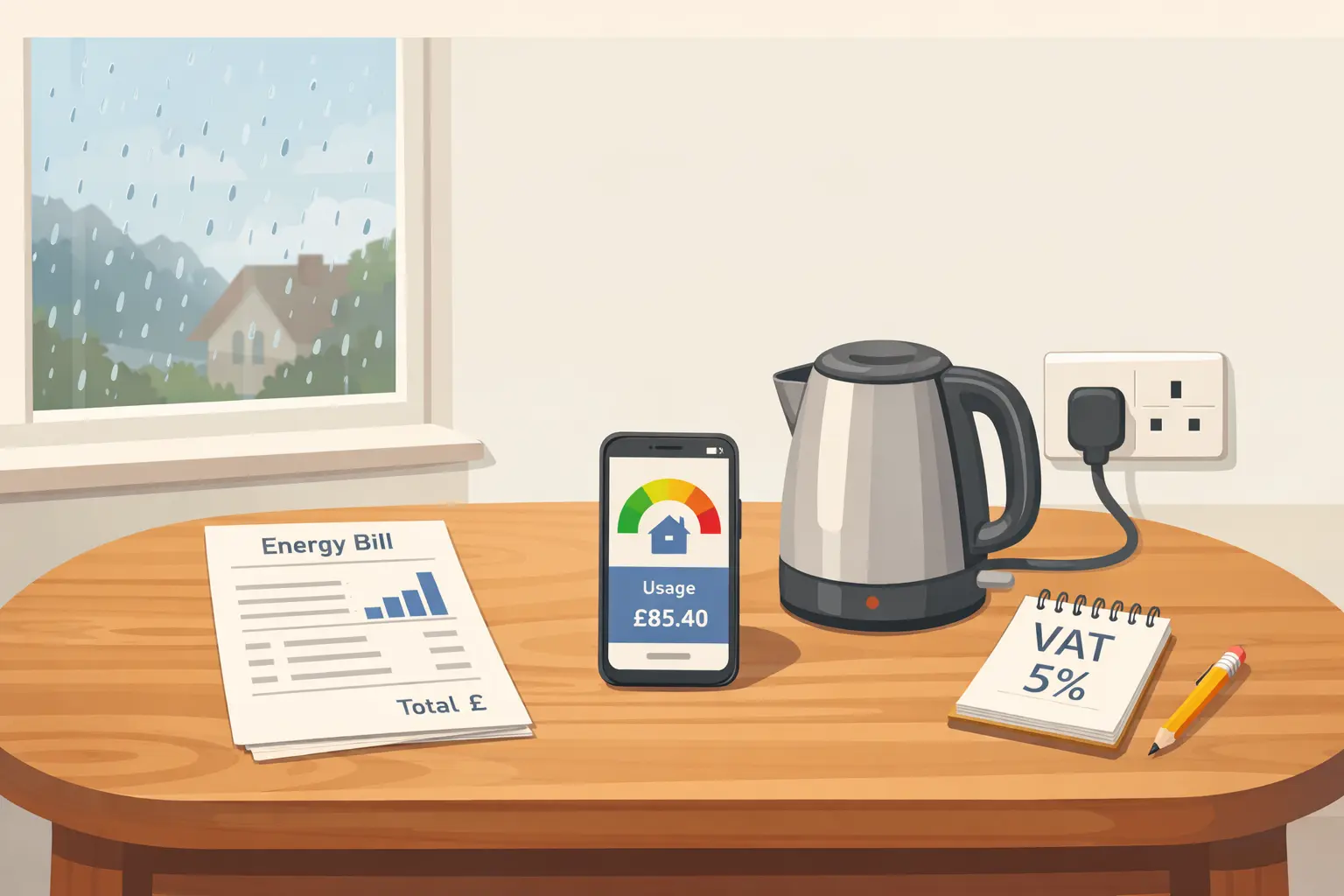
You open your energy app, see the total, and think: “Hold on… why is it higher than the unit rate x my usage?”
That little extra often isn’t “mystery fees” — it’s the boring-but-important stuff like standing charges, network costs… and VAT on energy bills.
Here’s the twist: most people in the UK do pay VAT on their gas and electricity, but not at the headline 20% you see on most shopping receipts. It’s usually much lower — and knowing the difference can help you understand your winter bills, compare tariffs properly, and avoid common billing misunderstandings.
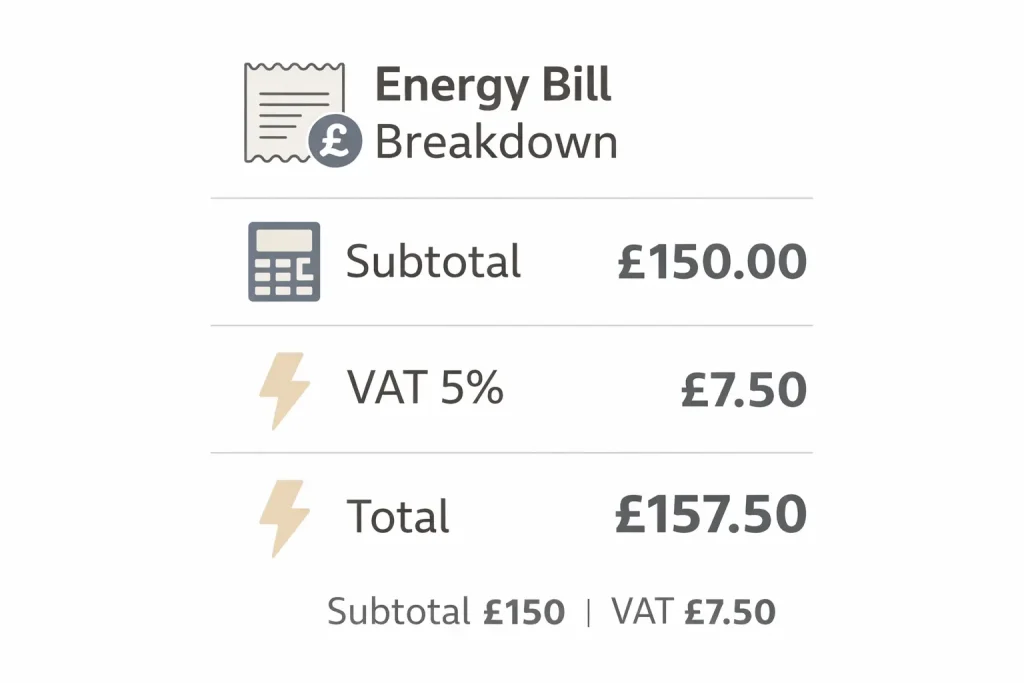
Most UK households pay VAT on gas and electricity, and the VAT rate on domestic energy is typically 5% (reduced rate), not 20%. VAT may be shown as a separate line on your bill or already included in quoted rates such as Ofgem price cap figures. How much VAT you pay depends on your total charges — at 5%, a £150 subtotal adds about £7.50 VAT — and your overall bill varies by usage, home size, insulation, region, meter type, and payment method.
What is VAT on energy bills in the UK?
VAT (Value Added Tax) is a tax added to most goods and services in the UK. Domestic gas and electricity are normally charged at a reduced VAT rate of 5% rather than the standard 20%.
That’s why you’ll often see “VAT 5%” on your bill summary — especially if you’re in a flat, a rented house, or student accommodation.
Quick mini-summary:
Most UK households pay VAT on gas and electricity, and it’s usually 5% for domestic use.
Is there VAT on energy bills, or is it already included?
Is there VAT on energy bills?
Yes — in most cases, there is VAT on energy bills. It’s commonly shown as a separate line (e.g., “VAT @ 5%”) or baked into quoted rates depending on how you’re viewing prices.
Is VAT already included in the price cap and quoted unit rates?
Often, yes. For example, Ofgem’s price cap figures and many consumer-facing comparisons are shown including 5% VAT.
So if you’re comparing tariffs:
- Some pages show “inc. VAT”
- Others show “ex. VAT” (less common for household-facing info)
Quick mini-summary:
VAT is usually charged on domestic energy, and many “headline” rates you see (like Ofgem price cap numbers) are already shown including VAT.
What is the VAT rate on domestic gas and electricity?
What is the VAT rate on domestic gas and electricity?
For most homes in Great Britain, the reduced rate is 5% VAT for qualifying domestic use of fuel and power.
This usually covers:
- Houses, flats, maisonettes
- Student halls or eligible residential accommodation (in many cases)
- Certain charity/non-business residential use in specific contexts
Important reality check: your total bill still depends on usage, insulation, your meter type, how you pay, and where you live. Rates can also vary by region and tariff.
Quick mini-summary:
The standard answer to “what is the vat rate on domestic gas and electricity” is 5%, but your overall bill still varies by home, region, and usage.
How much is VAT on energy bills in real terms?
How much is VAT on energy bills?
If you’re asking how much is vat on energy bills, the simplest way to think about it is:
- VAT is typically 5% of the energy charges on your bill (often including the standing charge too, depending on bill structure).
- If your bill subtotal before VAT is £100, VAT at 5% is £5.
Here’s a simple illustration:
| Example monthly subtotal (before VAT) | VAT rate | VAT amount | Total (incl. VAT) |
|---|---|---|---|
| £80 | 5% | £4.00 | £84.00 |
| £150 | 5% | £7.50 | £157.50 |
| £250 | 5% | £12.50 | £262.50 |
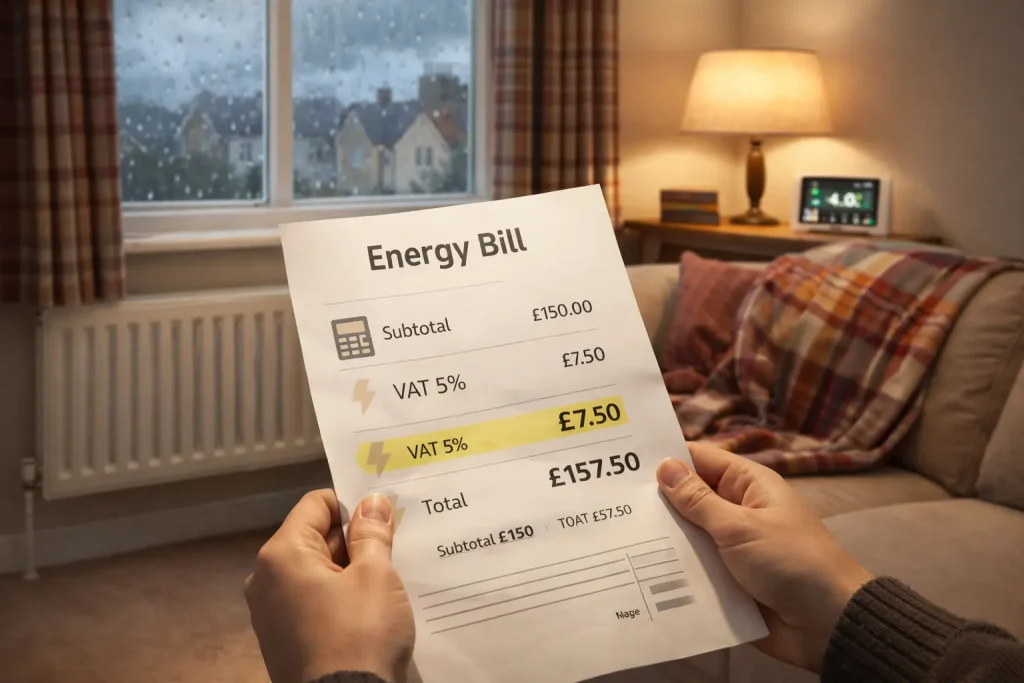
In winter, VAT can feel more noticeable because your usage rises (heating, longer dark evenings, more time at home). But the VAT rate itself doesn’t suddenly change — your consumption does.
If you want a real-world anchor: Ofgem’s published price cap unit rates and standing charges are often presented including 5% VAT, which helps comparisons feel more “what you actually pay.”
Quick mini-summary:
“How much” VAT you pay depends on your bill size. At 5%, a £150 subtotal adds about £7.50 VAT — and winter usage makes it feel bigger.
Do you pay VAT on energy bills if you’re renting or living in a flat?
Do you pay VAT on energy bills as a tenant?
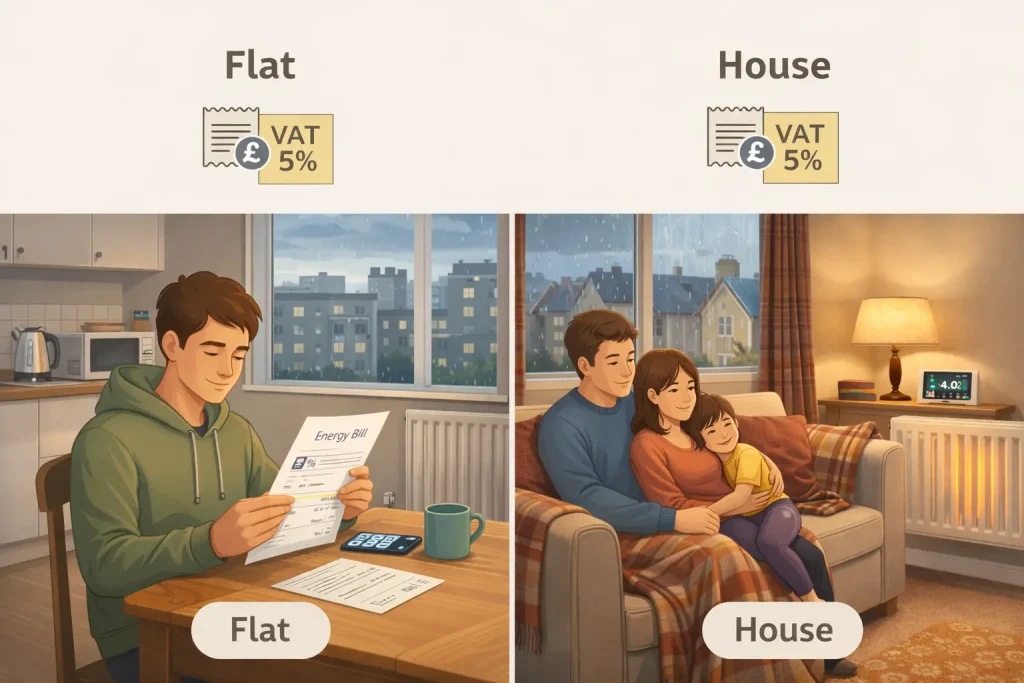
Usually, yes — if your name is on the energy account, you’ll see VAT on your bill like any other household.
But there are a few common setups where people get confused:
- Bills included in rent (all-inclusive): you may not see VAT separately, because the landlord/agent pays the supplier and builds costs into your rent.
- HMO / shared house with one bill-payer: only the account holder sees the full bill breakdown.
- Student accommodation: sometimes the billing structure is handled by the accommodation provider; VAT treatment can vary depending on how it’s supplied and classified (but domestic/residential supply often still benefits from reduced VAT in qualifying cases).
Quick mini-summary:
Most renters do pay VAT on energy bills — you may just not see it if bills are bundled into rent or handled by an accommodation provider.
Why is VAT on energy bills only 5% and not 20%?
Why does domestic energy get a reduced VAT rate?
The UK applies a reduced VAT rate to domestic fuel and power to keep essential household energy more affordable than it would be under the standard rate. HMRC guidance treats qualifying domestic use differently from standard commercial consumption.
That said, the politics and policy debates around energy bills change over time. There have been recent discussions in the press about whether the 5% VAT should be cut further, but as of the most recent official guidance and mainstream billing practice, 5% remains the typical domestic VAT rate.
Quick mini-summary:
Domestic energy usually benefits from a reduced VAT rate (5%) because it’s considered essential household spending, and that approach is reflected in HMRC guidance.
When might VAT on energy be 20% instead?
When is the VAT rate higher than 5%?
This is where people (especially small business owners and self-employed renters) trip up.
In general:
- Domestic household supply → usually 5% VAT
- Business supply → often 20% VAT, unless it qualifies for reduced treatment under specific rules (including de minimis thresholds and qualifying use).
Sık yapılan hata (gerçek hayatta çok görüyorum):
People working from home assume they should automatically be on “business energy” with 20% VAT. In reality, many home-working situations are still supplied as domestic, but it depends on how the supply is set up and classified. If you’re unsure, the safest move is to check the bill wording and ask the supplier how your supply is categorised. (This is information-only, not financial advice.)
Quick mini-summary:
5% VAT is typical for homes, but business supplies can be charged at 20% unless special criteria apply. If you work from home, don’t assume — check how your account is classified.
How can you check VAT on your energy bill?
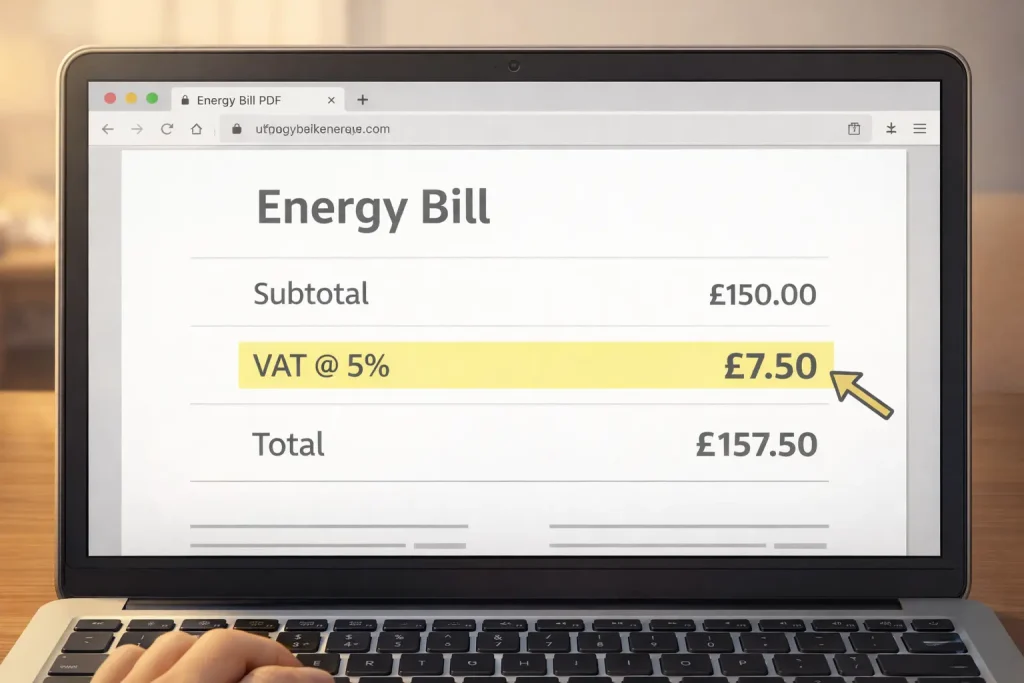
How do you find the VAT line on a UK energy bill?
Most suppliers make this easy:
- Open your bill PDF/app statement
- Look for a section like “Summary” or “Charges”
- Find a line that says VAT @ 5% (or sometimes “VAT included”)
If you’re comparing deals, also check whether quoted prices are “inc. VAT” so you’re not comparing apples to oranges.
Quick mini-summary:
Look for “VAT @ 5%” on your bill summary, and when comparing tariffs, make sure the rates are shown either both inc. VAT or both ex. VAT.
In the UK, VAT on energy bills is usually charged at the reduced rate of 5% for domestic gas and electricity. If you’re wondering “is there vat on energy bills” or “do you pay vat on energy bills,” the answer is generally yes — and many published unit rates (including Ofgem price cap figures) are shown including VAT. “How much is vat on energy bills” depends on your bill size: 5% adds £5 per £100 of charges. Business supplies can be charged at 20% unless specific rules apply, so it’s worth checking how your account is classified.
How does VAT show up on your energy bill — as a separate line (e.g., “VAT @ 5%”) or simply as “VAT included”? If you want, share the wording from your bill summary (no personal details) and I’ll help you interpret what it means and where the VAT is being applied.