

Bringing a child into your life through adoption is a huge, wonderful step. As you get ready to welcome your new family member, you're probably also thinking about the practical side of things, like time off work and how you'll manage financially.
Thankfully, the UK has strong legal protections in place for adoptive parents. The system is designed to give you the time and financial breathing room you need to focus on what matters most: bonding with your child.
Welcoming Your Child: The Essentials of UK Adoption Leave

Let's cut through the legal jargon. When you adopt, you're entitled to take up to 52 weeks off work. This is your adoption leave. It’s a statutory right, meaning it's protected by law.
Think of it as a parallel to maternity leave. The idea is to give all new parents a fair and consistent amount of time to settle in with their child, whether they gave birth or adopted. It’s a crucial bridge between your life at work and your new life as a parent.
This guide will walk you through exactly what you're entitled to, who qualifies, and what you need to do to get it all sorted.
UK Adoption Leave At a Glance
Here’s a quick summary of the key entitlements for adoptive parents.
| Entitlement | What You Get |
|---|---|
| Total Leave Duration | Up to 52 weeks of adoption leave. |
| Leave Structure | The first 26 weeks are ‘Ordinary Adoption Leave’, and the next 26 weeks are ‘Additional Adoption Leave’. |
| Statutory Adoption Pay (SAP) | Paid for up to 39 weeks. |
| SAP Rate | The first 6 weeks are paid at 90% of your average weekly earnings. |
| SAP Rate (Weeks 7-39) | The remaining 33 weeks are paid at £172.48 per week or 90% of your average earnings (whichever is lower). Rates are for the 2023/24 tax year. |
| Eligibility | You must be an employee, give your employer the correct notice, and meet certain earnings criteria. |
This table gives you the headlines, but we’ll dive into the details of what each of these points means for you in the following sections.
A Closer Look at the Numbers
So, what does this actually mean for your bank account? The total 52 weeks of leave is a full year away from work, giving you plenty of time to build those all-important bonds. It’s split into two 26-week blocks: Ordinary Adoption Leave (OAL) and Additional Adoption Leave (AAL).
This one-year structure is a real recognition from the government that building a family through adoption takes time, love, and focus. It’s there to support you through that incredible—and sometimes challenging—first year.
The financial side is handled by Statutory Adoption Pay (SAP). For the first 6 weeks, you’ll get 90% of your average weekly earnings.
After that, for the next 33 weeks, you’ll receive a flat rate. The rate from April 2023 is £172.48 per week, or 90% of your average earnings if that happens to be less. This fixed income provides a predictable foundation for your family budget. For the most up-to-date figures, it’s always worth checking the official government guidelines.
Who Qualifies for Adoption Leave and Pay

Before you can start planning for your new arrival, the first step is figuring out if you’re eligible for adoption leave and pay. The UK system has a few specific hoops to jump through, but they’re mainly there to support employees who have a settled relationship with their employer. Let’s break down exactly what you need.
The two main things that matter are your employment status and how long you’ve been on the payroll. First and foremost, you have to be an employee with a contract of employment. This is a crucial distinction, as other types of workers, like self-employed contractors, don’t have the same statutory rights.
The second part is all about your length of service. This is where the rules get a bit more detailed and where most people have questions.
The 26 Week Continuous Employment Rule
To get the green light for both Statutory Adoption Leave and Statutory Adoption Pay (SAP), you must have worked for your employer, without a break, for at least 26 weeks. This is calculated up to and including the week you are officially matched with a child.
Think of it as a loyalty benchmark. Hitting that 26-week mark shows a stable employment history, which is exactly what the statutory system is designed to support and protect. It’s a fundamental part of the adoption leave UK framework that both you and your employer need to understand.
What is the Matching Week?
The term ‘matching week’ might sound a bit official, but it’s a simple concept. It’s the week, running from Sunday to Saturday, when an adoption agency formally tells you that you’ve been matched with a child. This date is the anchor point for everything else.
So, if you get that amazing call from the agency on a Wednesday, your matching week actually started the previous Sunday. It’s from that Sunday that your 26-week employment history is measured.
Key Takeaway: Your eligibility isn’t based on when your child comes home. It’s all calculated from the week you are officially matched, which can be weeks or even months before the actual placement.
Getting this detail right is vital for planning. It means you need to look backwards from your matching week to check you have the continuous service you need. Knowing this can save you from any nasty surprises when you tell your boss.
A Practical Eligibility Checklist
To keep things simple, here’s a quick checklist you can run through to see if you meet the core requirements for Statutory Adoption Leave and Pay.
- Employee Status: Are you legally classed as an employee? (This is different from being a ‘worker’ or a self-employed contractor).
- Continuous Service: Have you been with your current employer for an unbroken 26 weeks leading up to your matching week?
- Correct Notice: Have you told your employer you plan to take leave within the required timeframe? (We’ll dive into this in the next section).
- Proof of Adoption: Are you able to provide proof of the adoption, like the matching certificate from your agency?
- Earnings Threshold (for SAP): Do you earn enough on average each week to meet the Lower Earnings Limit for National Insurance? You need to hit this for the pay, but you can still take unpaid leave even if you don’t.
If you can tick these boxes, you are legally entitled to the full 52 weeks of adoption leave. For couples adopting together, it’s worth remembering that only one person can be the ‘primary adopter’ and take adoption leave. The other partner might be able to take paternity leave, or you could explore Shared Parental Leave. If you’re navigating this journey from abroad, our guide on the Parent Visa UK might also come in handy for related immigration questions.
Figuring Out Your Statutory Adoption Pay
Getting your head around how Statutory Adoption Pay (SAP) is actually calculated is the first step to planning your family’s budget for your time off. It’s not just one single weekly payment. Instead, the system is designed with two different rates to give you a bit more financial support right at the start when your child comes home.
Let’s break down exactly how it works so you can get a clear picture of what your income will look like.
For the first 6 weeks of your adoption leave, you’ll receive 90% of your average weekly earnings. This higher initial rate is a real help, designed to soften the financial shift as you all settle in as a new family.
After those first six weeks are up, the pay rate changes. For the remaining 33 weeks, you’ll get the standard statutory amount. For the 2024/25 tax year, that’s £184.03 per week. If 90% of your average weekly pay happens to be less than this, you’ll receive that lower amount instead. This provides a steady, predictable income for the main chunk of your leave.
How Your “Average Weekly Earnings” Are Worked Out
So, how does your employer land on that “average weekly earnings” figure for your first six weeks? It’s not as simple as just looking at your last payslip. They have to use a specific eight-week period that happens just before you are officially matched with your child.
This “relevant period,” as it’s called, is really important. Your employer will take your total gross earnings (that’s your pay before any tax or National Insurance comes off) from the eight weeks leading up to the end of the week you were matched. They then find the average, and that’s the magic number used to calculate your pay.
Why the eight-week window? Using this period helps to smooth out any blips in your pay, like a one-off bonus or a bit of overtime. It gives a much fairer picture of your typical income, so the 90% figure is a true reflection of what you usually earn.
The official government guidance, shown in the screenshot below, sets out these two payment stages very clearly.
As you can see, it confirms that initial higher-rate period, followed by the standard weekly payment for the rest of your time off.
A Real-World Example: Salaried Employee
Let’s put this into practice. Say Sarah earns a flat salary of £35,000 a year.
- Work out her weekly pay: First, we turn her annual salary into a weekly figure: £35,000 ÷ 52 weeks = £673.08 per week.
- Calculate the first 6 weeks’ pay: For this initial period, Sarah gets 90% of that weekly amount.
- £673.08 x 0.90 = £605.77 per week.
- Work out the next 33 weeks’ pay: For the rest of her paid leave, she’ll get the standard statutory rate, because her 90% figure is much higher.
- £184.03 per week (the 2024/25 rate).
So, Sarah can expect £605.77 a week to start with, which will then switch to the standard government rate for the remainder of her paid leave.
Another Example: Fluctuating Pay
What if your pay isn’t the same every month? Let’s look at Alex, who works variable hours. To calculate his average, his employer looks at his gross earnings over the eight-week relevant period:
- Week 1: £550
- Week 2: £620
- Week 3: £580
- Week 4: £600
- Week 5: £540
- Week 6: £630
- Week 7: £590
- Week 8: £610
- Add it all up: First, we total his earnings across the eight weeks: £550 + £620 + £580 + £600 + £540 + £630 + £590 + £610 = £4,720.
- Find the weekly average: Now, we divide that total by eight: £4,720 ÷ 8 = £590 per week.
- Calculate the first 6 weeks’ pay: Alex will get 90% of this average.
- £590 x 0.90 = £531 per week.
- Work out the next 33 weeks’ pay: Just like Sarah, his 90% figure is higher than the statutory rate, so he’ll move onto the standard amount after the first six weeks.
- £184.03 per week.
This method ensures that even if your pay packet changes week to week, your adoption pay is still based on what you actually earn.
Don’t Forget About Tax and National Insurance
This is a really important point to remember: Statutory Adoption Pay is treated just like a normal salary. That means it’s subject to deductions for both Income Tax and National Insurance.
The figures we calculated above are your gross entitlement. The amount that actually hits your bank account will be lower once tax and NI have been taken off. Make sure you factor this into your budget! If you’re trying to get a better sense of how deductions impact your earnings, looking at guides that explain how much a £45k salary is per hour can be really useful for understanding take-home pay.
How to Give Notice to Your Employer
You’ve just received the amazing news that you’ve been matched with a child—congratulations! Now, the clock officially starts on letting your employer know about your plans to take adoption leave. Getting this conversation right from the start makes everything smoother for both you and your workplace. It gives them time to plan for your cover and ensures your Statutory Adoption Pay is processed without a hitch.
The timeline for giving notice is quite strict. You must tell your employer you intend to take adoption leave within seven days of being matched with a child. It’s a tight turnaround, but it’s a crucial legal deadline.
When you give notice, you don’t need to write an essay. You just need to tell them two key things: the date the child is expected to come and live with you, and the date you’d like your adoption leave to start.
Key Deadlines and What to Provide
When it comes to giving notice, timing really is everything. That seven-day window is a legal requirement, so it pays to be ready to act as soon as you get the call. Think of it less like a formal demand and more like a professional heads-up that helps everyone get organised.
Here’s exactly what you need to share in that initial notice:
- The ‘date of placement’: This is the day you expect your new child to come home.
- Your intended start date: This is when you want your 52 weeks of adoption leave to kick off. You’ve got a bit of flexibility here—you can start it up to 14 days before your child is placed with you.
You’ll also need to formally state that you want to take adoption leave and receive Statutory Adoption Pay. It might seem obvious, but putting it in black and white avoids any confusion down the line.
Expert Tip: I always advise putting your notice in writing, whether it’s a clear email or a more formal letter. This gives both you and your HR department a paper trail to refer back to, so there are no misunderstandings about dates or entitlements.
To make this step as clear as possible, here’s a quick overview of what needs to happen and when.
Adoption Leave Notification Timeline
This table breaks down the key actions you need to take when formally requesting your adoption leave.
| Action Required | When to Complete It | Key Details |
|---|---|---|
| Initial Notification | Within 7 days of being matched with a child. | Inform your employer of your intention to take adoption leave. |
| Provide Key Dates | In your initial notification. | State the child’s expected placement date and your desired leave start date. |
| Submit Proof of Adoption | When your employer requests it (usually after your initial notice). | Provide the matching certificate from your adoption agency. |
| Confirm Leave Details | Your employer must respond within 28 days. | They will confirm your leave start and end dates in writing. |
Following this timeline ensures you meet all your legal obligations and keeps the process moving smoothly.
Providing Proof of Adoption
Along with your written notice, your employer will need to see some official paperwork. This is a standard and necessary step for them to authorise your leave and pay. You don’t have to provide it in that first seven-day rush, but they are entitled to ask for it.
The document you’ll need is your matching certificate, which you’ll get from your adoption agency. It’s the official confirmation of the match and includes all the key dates your employer needs. If you’re adopting from overseas, the equivalent document is an ‘official notification’ confirming you have permission to adopt.
This timeline gives you a visual guide to how Statutory Adoption Pay works once your leave begins.
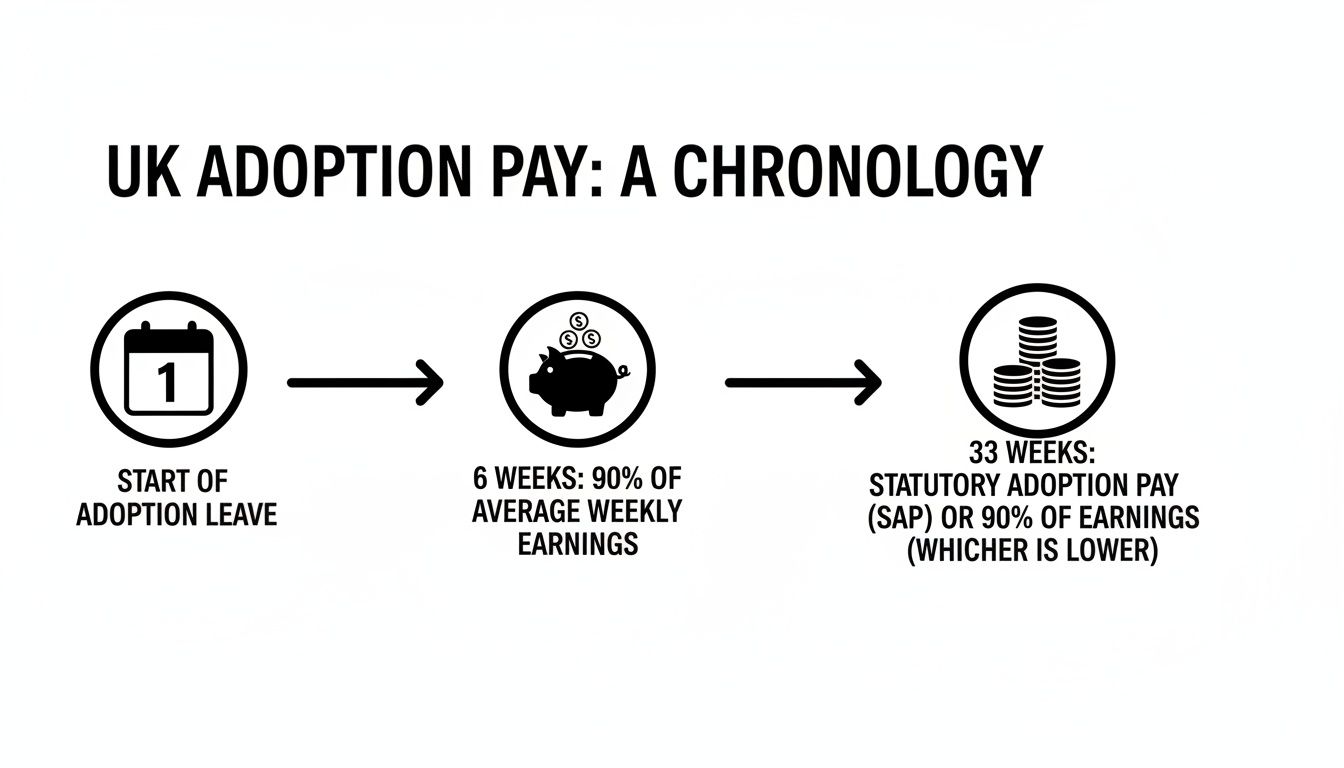
As you can see, the pay is structured to give you more financial support during those crucial first few weeks of bonding with your new child.
Understanding Your Rights During and After Leave

Starting your adoption leave UK journey is a huge moment. But alongside the excitement, it’s completely normal to have questions about what it all means for your job. What will things look like when you get back?
The good news is that UK law offers a solid safety net to protect your career. These rights are there to give you the peace of mind to focus on what truly matters: your new family. Your employment doesn’t just hit pause; many of your rights and benefits keep ticking along while you’re away.
Your Right to Return to Work
Let’s tackle the biggest worry first: job security. The law is really clear here, and what happens depends on how much leave you decide to take.
Returning within the first 26 weeks (Ordinary Adoption Leave): If you come back to work during or at the end of this period, you have the right to your exact same job. No ifs, no buts. It’s the same role, same seniority, same location, and the same terms you had before you left.
Returning after 26 weeks (Additional Adoption Leave): Taking longer than 26 weeks gives your employer a little more flexibility, but your rights are still strong. You’re still entitled to your original job. Only in rare situations where your employer can prove it’s not reasonably practical to give you the same role back must they offer you a suitable alternative job with the same or better pay and conditions.
This is a powerful protection. It means you can’t be penalised for taking time off to grow your family, and it shields you from redundancy or dismissal just because you took adoption leave.
Keeping Your Benefits While on Leave
While your regular salary is replaced by Statutory Adoption Pay (SAP), many of your other valuable work benefits keep building up in the background. It’s a crucial detail that’s easy to miss when planning your finances.
Think of your employment contract as being on hold, not cancelled. This means key entitlements continue to accumulate just as if you were still at your desk.
Key Takeaway: Your paid holiday entitlement continues to build for the entire 52 weeks of your adoption leave. This often means you’ll return to work with a good chunk of paid time off to take, or you might agree with your employer to be paid for it instead.
Pension contributions are also protected. Your employer must continue paying their contribution based on your normal salary. Your own contributions will be based on the SAP you’re receiving, which helps keep your long-term financial planning on track. For help with managing your finances during this period, have a look at our practical budgeting tips for UK households.
Staying Connected with Keeping in Touch Days
Worried about feeling out of the loop while you’re away? The system has a brilliant solution for that: Keeping in Touch (KIT) days. They’re a fantastic, low-pressure way to ease your eventual return to work.
You can work up to 10 KIT days during your adoption leave without it affecting your statutory pay or officially ending your leave. The key thing is that you and your employer must both agree to them. They can’t force you to work, and they don’t have to offer them.
These days are super flexible and can be used for anything that counts as work, like:
- Popping in for an important team meeting
- Attending a training course
- Working on a project to help with a handover
You must be paid for any KIT days you work, at a rate you agree on with your employer beforehand. It’s a great way to stay connected on your own terms. For families navigating the adoption system, where placement numbers are relatively low—for instance, with only 182 children adopted from care in England in 2023/24—the financial security provided by adoption leave and pay is a critical support. You can find more details in the official government statistics on children looked after in England.
Adoption Leave vs. Shared Parental Leave: What’s the Difference?
Once you’ve got your head around the basics of adoption leave, there’s another layer to consider that can offer your family a huge amount of flexibility: Shared Parental Leave (SPL). The easiest way to think about it is this: standard adoption leave is a straightforward, year-long block assigned to one parent. SPL, on the other hand, is like a big, flexible pot of leave and pay that you and your partner can dip into as you see fit.
Essentially, the primary adopter can choose to cut their adoption leave short. Whatever they haven’t used—both in terms of time off and statutory pay—gets poured into this shared pot. From there, you can both decide how to use it, whether that means taking time off together right at the start or staggering your leave to make sure one of you is always home for longer.
It All Comes Down to Flexibility
The real difference between the two is structure versus freedom. Adoption leave is a simple, continuous block of up to 52 weeks for one person. It’s a solid, predictable option that gives you a long, unbroken stretch of time to bond with your new child.
Shared Parental Leave is where things get more interesting. It lets you carve up that time into smaller chunks, deciding who takes leave and when. This can be a game-changer for juggling childcare, easing one person back into work, or simply making sure both partners get that precious one-on-one time in the early months.
When you convert adoption leave into SPL, you aren’t giving anything up. You’re just trading a fixed block of time for a more agile resource that you and your partner can share, giving you far more say over how you manage that first critical year.
How It Works in the Real World
Let’s walk through an example. Imagine Tom and Chloe are adopting. Tom is named the primary adopter, so he’s entitled to the full 52 weeks of adoption leave and 39 weeks of Statutory Adoption Pay (SAP). He takes the first 20 weeks off to welcome their child home and help everyone settle in, but then decides he’s ready to go back to work part-time.
Here’s how they could switch to Shared Parental Leave:
- Curtail the Leave: Tom simply tells his employer he wants to end his adoption leave on a specific date.
- Create the Pot: This move instantly creates their SPL pot. The remaining 32 weeks of his leave (52 – 20) and 19 weeks of his pay (39 – 20) are now available for them to share.
- Share it Out: Now, the fun part begins. They can start planning how to use that shared time and pay.
This simple switch opens up possibilities that just aren’t on the table with traditional adoption leave.
A Smart Strategy for Tom and Chloe
With their new pot of SPL, Tom and Chloe sit down to look at their calendars, finances, and work schedules. They decide to stagger their leave to keep a parent at home for longer and to help support each other’s return to work.
Here’s one way they could split their remaining 32 weeks of leave:
- Tom’s Phased Return: To ease back in, Tom decides to work a three-day week for the next 10 weeks. He uses two days of SPL per week to make this happen, giving him a softer landing back at the office.
- Chloe’s Turn: Once Tom is back full-time, Chloe takes a solid 12-week block of SPL. This gives her a substantial period of time to take the lead on childcare.
- Time Together: They deliberately save the last 10 weeks of leave. Their plan is to take it at the same time over the summer holidays, giving them a long, uninterrupted stretch of family time before their child starts nursery.
As you can see, SPL isn’t just about taking time off. It’s a powerful tool for finding the right balance between work, family, and your finances during one of the most important years of your life.
Your Top Questions About UK Adoption Leave Answered
Getting to grips with adoption leave often throws up a few specific questions, especially when you start applying the rules to your own life. Let’s clear up some of the most common queries people have.
What If My Employer Offers More Than the Minimum Pay?
You might be in luck! Many companies now offer ‘enhanced’ or ‘contractual’ adoption pay, which is a great perk that tops up the legal minimum. This can make a real difference to your finances while you’re settling in with your new family.
Be sure to dig out your employment contract or check the staff handbook for the specifics. An enhanced package can’t offer you less than the statutory entitlement, but it can certainly improve it – for instance, by paying 90% of your salary for longer, or by providing some level of pay for more of the 39 weeks.
Can Both Partners Take Adoption Leave?
This is a common point of confusion. The short answer is no; the main 52-week adoption leave is designed for one person, who becomes the ‘primary adopter’.
But that doesn’t leave the other partner high and dry. They can usually take paternity leave. More importantly, you can both look into Shared Parental Leave. This brilliant system lets you carve up the primary adopter’s remaining leave and pay between you, giving you much more flexibility.
Think of it this way: while only one person can be the ‘primary adopter’ to kick things off, Shared Parental Leave is there to give you both more control over how you split the childcare during that crucial first year.
What Happens If a Placement Is Disrupted?
In the incredibly difficult event that a placement ends unexpectedly during your leave, the law provides a buffer to help you cope. Your adoption leave doesn’t just stop overnight.
You can continue your leave for up to eight weeks after the week the placement ended. Your Statutory Adoption Pay will also continue for that same eight-week period, giving you some financial and professional breathing room during an unimaginably tough time.
At UK Life Costs, we provide clear, data-led guides to help you plan your finances for major life events. Our tools and articles break down the real costs of living across the UK so you can budget with confidence. Find out more at https://uklifecosts.com.