

Living next to a bothersome neighbour may make even the most routine tasks more stressful. Many people in the UK are unsure of how to complain about a neighbour to the council due to problems such excessive noise, antisocial behaviour, waste, or persistent arguments.
The best and most legal way to have problems resolved is to contact the council, which could be a scary prospect. Here you will find all the information you need to know, including when to contact the council, how to make a complaint, the documentation that is necessary, and what to anticipate from the process.
You will get the confidence to properly handle complaints about loudness, harassment, or environmental concerns after reading this article.
When Should You Complain About a Neighbour to the Council?

Recognising when council involvement is appropriate is required before contacting them.
The majority of the time, the council will step in when a neighbour does:
- Is constant or repeated
- Influence your safety, quality of life, or both
- Assumed compliance with rules governing anti-social conduct and ecological safety
Issues the Council Can Handle
You can complain to the council about a neighbour when you are having problems for the following reasons:
- Nonstop noise (as a dog barking, a concert, or a shout)
- Antisocial or harassing conduct
- Overflowing garbage cans or flytipping
- There is an unpleasant odour, smoke, or other contaminants present.
- Property that is unsafe or neglected
- The noise from a business or rental property
Before little disputes or isolated instances become major crises, try to settle them calmly.
Try to Resolve the Issue First (If Safe)
Most councils require you to attempt informal resolution before submitting a formal complaint.
Speak to Your Neighbour (If Possible)
If you are comfortable doing so, politely explaining the problem might sometimes result in a quick settlement.
- You need to choose a neutral time
- Do not interfere
- Keep your cool and tell the truth at all times.
If the situation requires aggression, threats, or intimidation, do not approach them directly.
How to Complain About a Neighbour to the Council: Step-by-Step
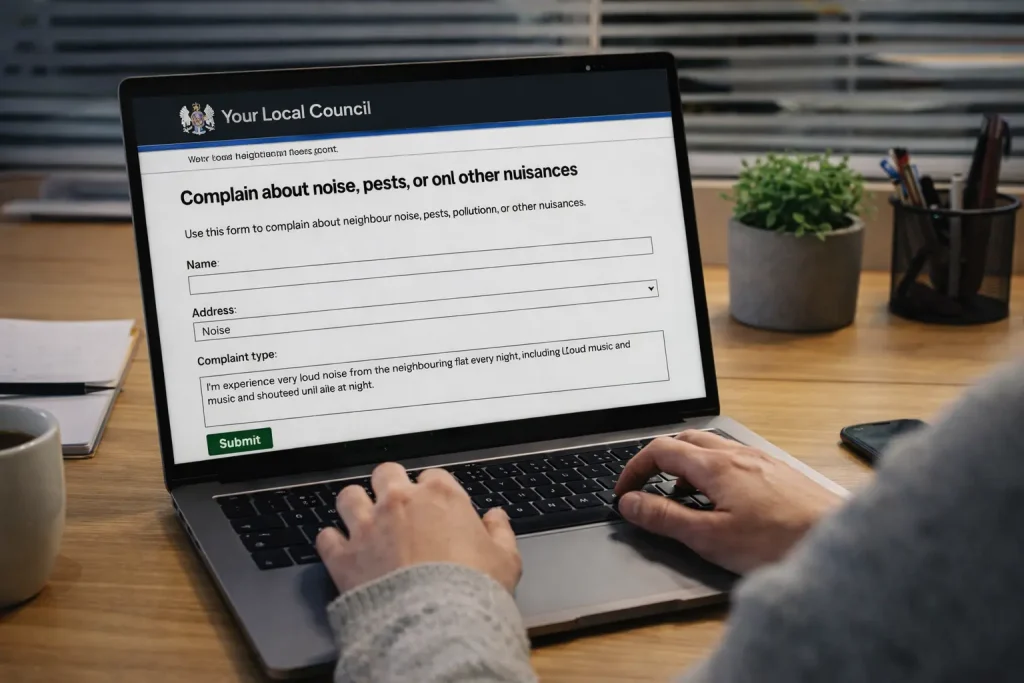
If more informal methods have been tried, here is how to complain about a neighbour to the council.
Step 1: Identify the Correct Council Department
Various teams are responsible for handling various issues:
| Issue Type | Council Department |
|---|---|
| Noise complaints | Environmental Health |
| Anti-social behaviour | Community Safety / ASB Team |
| Rubbish & fly-tipping | Environmental Services |
| Housing issues | Housing Department |
In most cases, you may get the necessary papers on your local council’s website.
Step 2: Gather Evidence
Having good evidence can significantly boost the efficacy of your complaint.
Facts that are helpful consist of:
- Incident timings and dates
- Journals of background noise
- Media files (where permitted)
- Accounts provided by other nearby residents
- Communication between you and your neighbour
Official diary sheets are available from a number of municipalities in order to record noise or irritation complaints.
Step 3: Submit a Formal Complaint
Most councils allow you to complain:
- Online via a complaint form
- By phone
- By email
- In writing
Clarity, accuracy, and specificity are key. Stay away from sentimental language and focus on facts.
Step 4: Council Investigation
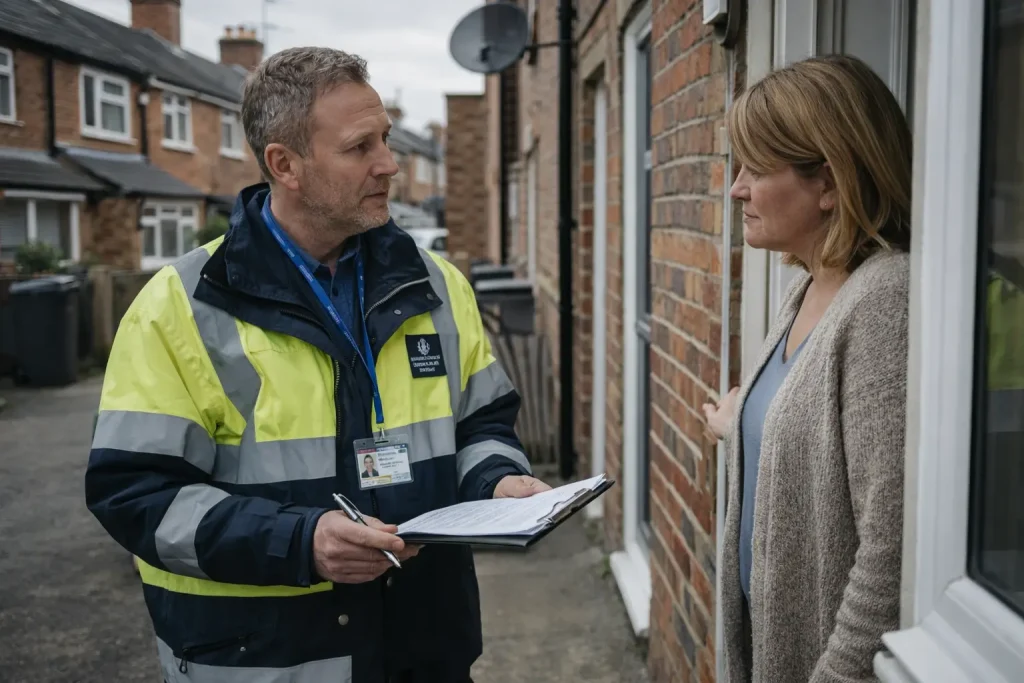
It is possible for the council to:
- Make contact with your next-door neighbour.
- Keep an eye on
- Put noise detectors in place.
- Check out the place
- Notify people or provide warnings
The intensity determines the duration, which might range from weeks to months.
What Happens After You Complain?
To keep expectations in check, it helps to know what’s coming up next.
Possible Outcomes
The council has the authority to:
- Put out a friendly caution
- Send a notification to cease and desist
- Levy penalties
- Proceed with legal processes
- Proceed with the mediation.
Enforcement does not always follow a complaint, particularly when the proof is lacking.
Can You Complain Anonymously?
Yes, in most instances.
Anonymous Complaints
When it comes to reporting, anonymity is permissible to a number of councils:
- Concerns about the volume
- Problems with the environment
- Unsocial conduct
However, it may prove to be more difficult to investigate anonymous complaints, and your identify could still be revealed during enforcement.
How Long Does the Process Take?
A specific date is not yet set.
- For little noise issues, a couple of weeks
- One to three months for anyone displaying disruptive conduct
- Legislation enforcement: additional time
Patience and consistent reporting are often necessary.
Advantages and Disadvantages of Complaining to the Council

Advantages
- A formal and lawful agreement
- Lowers the likelihood of confrontations occurring face-to-face
- Could finally resolve long standing issues
- Protects both homeowners and renters
Disadvantages
- Slow process
- Requests evidence
- Might make tensions rise
- Possible outcome
Council involvement is frequently the most secure long term choice, notwithstanding the costs.
Common Mistakes to Avoid
Avoidable mistakes cause many complaints to fail.
Avoid:
- Disclosure in the absence of proof
- Using overly dramatic language
- Reports that end too soon
- Making concerns using harsh words
- Hoping for immediate outcomes
Consistency is key.
Frequently Asked Questions (FAQ)
How to complain about a neighbour to the council in the UK?
The specific mechanism utilised to receive complaints by your local council email, phone, or website will be determined by the kind of problem.
Can the council evict a neighbour?
In the most dire of circumstances, seeking either social housing or legal recourse may be necessary.
Will my neighbour know I complained?
Yes, in the majority of instances; nevertheless, authorities take great care to ensure that complainants remain anonymous.
What if the council does nothing?
You may choose to hire a lawyer, go through mediation, or take your case to the next level.
Can tenants complain or only homeowners?
Both, homeowners and renters alike have their voices heard by the municipal council.
Is Complaining to the Council the Right Step?
You must be aware of how to complain about a neighbour to the council if you want to preserve your home life and tranquilly. It may take some time, but if you’re determined and have the correct proof, you may find success.
Notifying the council is not excessive if the issue continues, affects your well-being, and informal solutions have not worked. Doing so is making use of the existing system to protect people.
There is a way to settle issues with your neighbours that is legal, safe, and quick if you know what you’re doing.